


Georg Ehrenfried Groß (July 26, 1893 – July 6, 1959) was a German artist known especially for his savagely caricatural drawings of Berlin life in the 1920s. He was a prominent member of the Berlin Dada and New Objectivity group during the Weimar Republic before he emigrated to the United States in 1933.
George Grosz was born Georg Ehrenfried Groß in Berlin, Germany, the son of a pub owner. His parents were devoutly Lutheran.[1] Grosz grew up in the Pomeranian town of Stolp,[2] where his mother became the keeper of the local Hussar's Officers' mess after his father died in 1901.[3][4] At the urging of his cousin, the young Grosz began attending a weekly drawing class taught by a local painter named Grot.[5] Grosz developed his skills further by drawing meticulous copies of the drinking scenes of Eduard Grutzner, and by drawing imaginary battle scenes.[6] From 1909–1911, he studied at the Dresden Academy of Fine Arts, where his teachers were Richard Müller, Robert Sterl, Raphael Wehle, and Oskar Schindler.[7] He subsequently studied at the Berlin College of Arts and Crafts under Emil Orlik.[7]
In November 1914 Grosz volunteered for military service, in the hope that by thus preempting conscription he would avoid being sent to the front.[8] He was given a discharge after hospitalization for sinusitis in 1915.[8] In 1916 he changed the spelling of his name to George Grosz as a protest against German nationalism[7] and out of a romantic enthusiasm for America[9] that originated in his early reading of the books of James Fenimore Cooper, Bret Harte and Karl May, and which he retained for the rest of his life.[10] (His artist friend and collaborator Helmut Herzfeld changed his name to John Heartfield at the same time.) In January 1917 he was drafted for service, but in May he was discharged as permanently unfit.[11]
Grosz was arrested during the Spartakus uprising in January 1919, but escaped using fake identification documents; he joined the Communist Party of Germany (KPD) in the same year. In 1921 Grosz was accused of insulting the army, which resulted in a 300 German Mark fine and the destruction of the collection Gott mit uns ("God with us"), a satire on German society. Grosz left the KPD in 1922 after having spent five months in Russia and meeting Lenin and Trotsky, because of his antagonism to any form of dictatorial authority.
Bitterly anti-Nazi, Grosz left Germany shortly before Hitler came to power. In June 1932, he accepted an invitation to teach the summer semester at the Art Students League of New York.[12] In October 1932, Grosz returned to Germany, but on January 12, 1933 he and his family emigrated to America.[13] Grosz became a naturalized citizen of the United States in 1938, and made his home in Bayside, New York. He taught at the Art Students League intermittently until 1955.
Made in Germany (German: Den macht uns keiner nach), by George Grosz, drawn in pen 1919, photo-lithograph published 1920 in the portfolio God with us (German: Gott mit Uns). Sheet 48.3 x 39.1 cm.
In America, Grosz determined to make a clean break with his past, and changed his style and subject matter.[14] He continued to exhibit regularly, and in 1946 he published his autobiography, A Little Yes and a Big No. In the 1950s he opened a private art school at his home and also worked as Artist in Residence at the Des Moines Art Center. Grosz was elected to the American Academy of Arts and Letters in 1954. Though he had US citizenship, he resolved to return to Berlin, where he died on July 6, 1959 from the effects of falling down a flight of stairs after a night of drinking.[15]
In 1960, Grosz was the subject of the Oscar-nominated short film George Grosz' Interregnum. In 2002, actor Kevin McKidd portrayed Grosz in a supporting role as an eager artist seeking exposure in a fictional film entitled Max, regarding Adolf Hitler's youth.
Although Grosz made his first oil paintings in 1912 while still a student,[7] his earliest oils that can be identified today date from 1916.[16] By 1914, Grosz worked in a style influenced by Expressionism and Futurism, as well as by popular illustration, graffiti, and children's drawings.[8] Sharply outlined forms are often treated as if transparent. The City (1916–17) was the first of his many paintings of the modern urban scene.[17] Other examples include the apocalyptic Explosion (1917), Metropolis (1917), and The Funeral, a 1918 painting depicting a mad funeral procession.
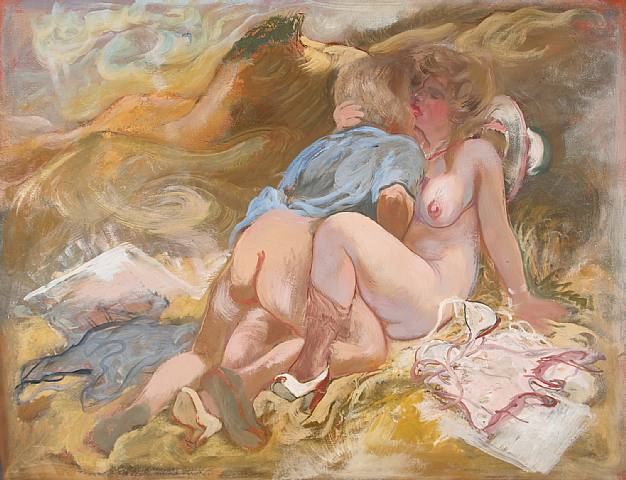
In his drawings, usually in pen and ink which he sometimes developed further with watercolor, Grosz did much to create the image most have of Berlin and the Weimar Republic in the 1920s. Corpulent businessmen, wounded soldiers, prostitutes, sex crimes and orgies were his great subjects. His draftsmanship was excellent although the works for which he is best known adopt a deliberately crude form of caricature. His oeuvre includes a few absurdist works, such as Remember Uncle August the Unhappy Inventor which has buttons sewn on it,[18] and also includes a number of erotic artworks.[19]
After his emigration to the USA in 1933, Grosz "sharply rejected [his] previous work, and caricature in general."[20] In place of his earlier corrosive vision of the city, he now painted conventional nudes and many landscape watercolors. More acerbic works, such as Cain, or Hitler in Hell (1944), were the exception. In his autobiography, he wrote: "A great deal that had become frozen within me in Germany melted here in America and I rediscovered my old yearning for painting. I carefully and deliberately destroyed a part of my past."[21] Although a softening of his style had been apparent since the late 1920s, Grosz's work turned toward a sentimental romanticism in America, a change generally seen as a decline.[22]
[edit] Quotes
* A deeply disillusioned man, he saw humanity as essentially bestial and the city of Berlin as a sink of depravity and deprivation, its streets crowded with unprincipled profiteers, prostitutes, war-crippled dregs and a variety of perverts. A communist, his feeling of social outrage stimulated him to produce the most biting drawings and paintings. -Trewin Copplestone
* In Grosz's Germany, everything and everybody is for sale. All human transactions, except for the class solidarity of the workers, are poisoned. The world is owned by four breeds of pig: the capitalist, the officer, the priest and the hooker, whose other form is the sociable wife. He was one of the hanging judges of art. -Robert Hughes
* My aim is to be understood by everyone. I reject the 'depth' that people demand nowadays, into which you can never descend without a diving bell crammed with cabbalistic bullshit and intellectual metaphysics. This expressionistic anarchy has got to stop... A day will come when the artist will no longer be this bohemian, puffed-up anarchist but a healthy man working in clarity within a collectivist society. -Grosz
* "My Drawings expressed my despair, hate and disillusionment, I drew drunkards; puking men; men with clenched fists cursing at the moon. . . . I drew a man, face filled with fright, washing blood from his hands. . . . I drew lonely little men fleeing madly through empty streets. I drew a cross-section of tenement house: through one window could be seen a man attacking his wife; through another, two people making love; from a third hung a suicide with body covered by swarming flies. I drew soldiers without noses; war cripples with crustacean-like steel arms; two medical soldiers putting a violent infantryman into a strait-jacket made of a horse blanket. . . I drew a skeleton dressed as a recruit being examined for military duty. I also wrote poetry.” -Grosz








.jpg!Blog.jpg)








_-_WGA04921.jpg)


